
Amps to Watts Calculator (DC, AC 1-Phase & 3-Phase)
Amps to watts converts current in amps into power in watts using the voltage: watts equal amps times volts for DC, with power factor added for AC. Use the DC, single-phase and three-phase calculators, then check the tables for 120 V and 240 V.
120 W P = V × I → 10 A with 12 V gives 120 W. 1620 W P = V × I × PF → 15 A with 120 V and PF 0.9 gives 1620 W. 9727.197335 W P = √3 × VL × I × PF → 30 A with 208 V and PF 0.9 gives 9727.197335 W.Amps to watts: DC
Amps to watts: AC single-phase
Amps to watts: AC three-phase (line-to-line)
How to convert amps to watts
Power is current times voltage. For AC loads multiply by the power factor, and for three-phase multiply by √3 (about 1.732) as well, using the line-to-line voltage.
| Circuit | Formula | Example |
|---|---|---|
| DC | P = V × I | 12 V × 10 A = 120 W |
| AC single-phase | P = V × I × PF | 120 V × 15 A × 0.9 = 1620 W |
| AC three-phase, line-to-line | P = √3 × VL × I × PF | 1.732 × 208 V × 30 A × 0.9 = 9727 W |
Worked example: a 20 A, 240 V circuit
At power factor 1, P = 240 × 20 = 4800 W. Because the NEC limits a continuous load to 80 percent of the circuit rating, a continuous load on that circuit should stay near 16 A, or 3840 W.
Worked example: a car battery charger
A charger that draws 5 A from a 120 V outlet at PF 0.95 uses 120 × 5 × 0.95 = 570 W of real power. That is the number the electric meter bills, not the 600 VA you get by ignoring the power factor.
Amps to watts table for 120 V and 240 V
Single-phase power at power factor 1 and 0.9.
| Amps | Watts at 120 V (PF 1) | Watts at 240 V (PF 1) | Watts at 120 V (PF 0.9) | Watts at 240 V (PF 0.9) |
|---|---|---|---|---|
| 0.5 | 60 | 120 | 54 | 108 |
| 1 | 120 | 240 | 108 | 216 |
| 2 | 240 | 480 | 216 | 432 |
| 3 | 360 | 720 | 324 | 648 |
| 5 | 600 | 1200 | 540 | 1080 |
| 8 | 960 | 1920 | 864 | 1728 |
| 10 | 1200 | 2400 | 1080 | 2160 |
| 12 | 1440 | 2880 | 1296 | 2592 |
| 15 | 1800 | 3600 | 1620 | 3240 |
| 16 | 1920 | 3840 | 1728 | 3456 |
| 20 | 2400 | 4800 | 2160 | 4320 |
| 24 | 2880 | 5760 | 2592 | 5184 |
| 30 | 3600 | 7200 | 3240 | 6480 |
| 32 | 3840 | 7680 | 3456 | 6912 |
| 40 | 4800 | 9600 | 4320 | 8640 |
| 48 | 5760 | 11520 | 5184 | 10368 |
| 50 | 6000 | 12000 | 5400 | 10800 |
| 60 | 7200 | 14400 | 6480 | 12960 |
| 80 | 9600 | 19200 | 8640 | 17280 |
| 100 | 12000 | 24000 | 10800 | 21600 |
Three-phase table: 208 V and 480 V
Power factor 0.9, P = √3 × VL × I × PF.
| Amps | Watts at 208 V | Watts at 480 V |
|---|---|---|
| 5 | 1621.2 | 3741.2 |
| 10 | 3242.4 | 7482.5 |
| 15 | 4863.6 | 11223.7 |
| 20 | 6484.8 | 14964.9 |
| 30 | 9727.2 | 22447.4 |
| 50 | 16212 | 37412.3 |
| 100 | 32424 | 74824.6 |
Watts, volt-amperes and kilowatts
Watts measure real power. Volt-amperes (VA) measure apparent power and equal volts times amps. Dividing watts by 1000 gives kilowatts (kW), and energy over time is measured in kilowatt-hours; see the kWh to watts converter for that step.
Related converters
Go the other way with watts to amps, or convert small currents with milliamps to amps. All converters are on the MicroCoulomb home page.
Low-voltage DC: 12 V, 24 V and 48 V
For batteries, solar and vehicles the voltage is low, so the same current gives much less power. 10 A at 12 V is 120 W, at 24 V it is 240 W and at 48 V it is 480 W. Use the DC calculator above with the battery voltage.
| Amps | Watts at 12 V | Watts at 24 V | Watts at 48 V |
|---|---|---|---|
| 1 | 12 | 24 | 48 |
| 2 | 24 | 48 | 96 |
| 5 | 60 | 120 | 240 |
| 10 | 120 | 240 | 480 |
| 15 | 180 | 360 | 720 |
| 20 | 240 | 480 | 960 |
| 30 | 360 | 720 | 1440 |
Common mistakes when converting amps to watts
- Multiplying amps by volts for an AC motor. That gives volt-amperes. Multiply by the power factor to get watts.
- Using the breaker rating as the load. A 20 A breaker does not mean a 20 A load; use the appliance current.
- Mixing phase and line voltage. The three-phase formula uses the line-to-line voltage.
- Forgetting the 80 percent rule. A continuous load should stay within 80 percent of the circuit rating under the NEC.
Reading an appliance nameplate
A nameplate lists volts, amps and often watts or VA. If it shows 120 V and 8 A, the apparent power is 960 VA. The real power in watts is lower or equal, depending on the power factor. When only amps are printed, the calculators above give a quick estimate of watts, which is useful for comparing devices or estimating energy use with kWh to watts.

Frequently asked questions
How do you convert amps to watts?
Multiply amps by volts for DC. For AC single-phase multiply by the power factor too, and for three-phase use √3 × volts × amps × power factor.
How many watts is 10 amps?
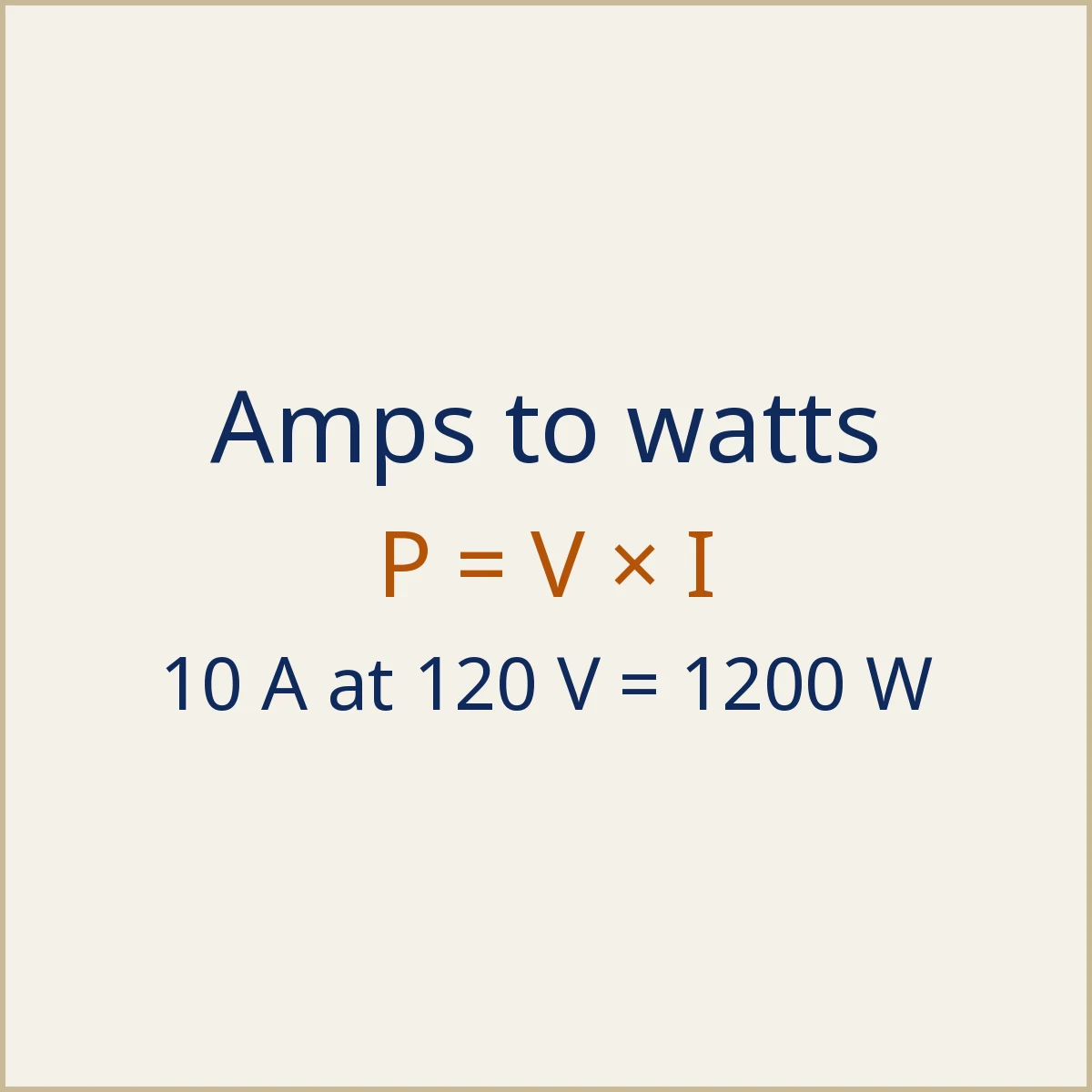
At 120 V and PF 1, 10 A is 1200 W. At 240 V it is 2400 W. At 12 V DC it is 120 W.
Why does the power factor lower the watts?
Because only part of the apparent power does real work in an AC circuit. Watts equal volt-amperes times the power factor.
Can I use this to size a breaker?
Only as a first estimate. Breaker and wire sizing must follow the NEC and a licensed electrician.
Updated