
kVA to Amps Calculator (Single & Three Phase)
kVA to amps converts apparent power in kilovolt-amperes into current in amps: divide kVA times 1000 by the voltage for single-phase, or by √3 times the line voltage for three-phase. The calculators below do both, and the tables show common transformer and generator sizes at 120 V, 240 V, 208 V and 480 V.
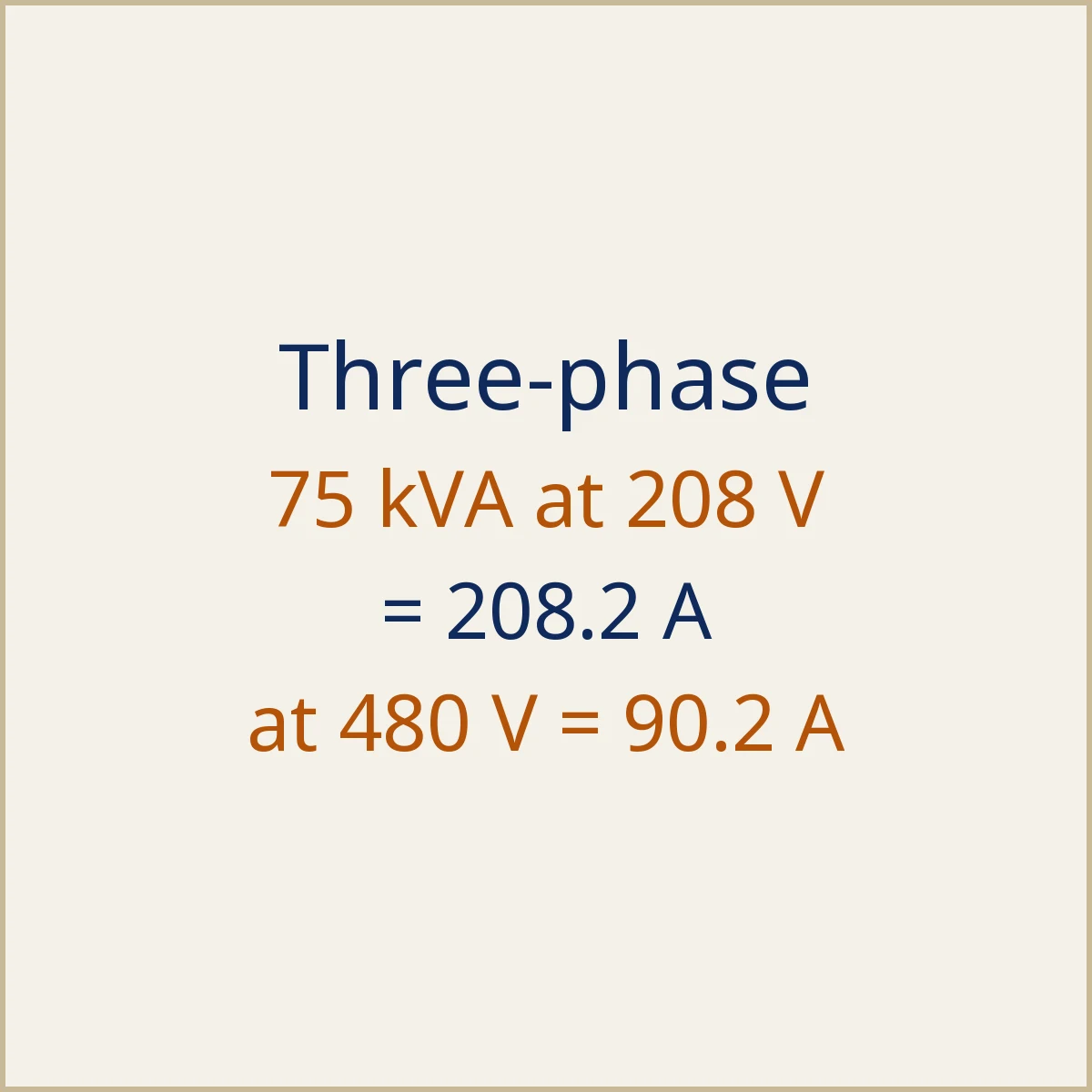
41.666667 A I = kVA × 1000 ÷ V → 10 kVA at 240 V gives 41.666667 A. 208.179184 A I = kVA × 1000 ÷ (√3 × VL) → 75 kVA at 208 V gives 208.179184 A.kVA to amps: single-phase
kVA to amps: three-phase (line-to-line)
How to convert kVA to amps
A kilovolt-ampere (kVA) is 1000 volt-amperes, the apparent power of a transformer, generator or UPS. Current follows from apparent power and voltage; no power factor is needed because kVA already includes it.
| Circuit | Formula | Example |
|---|---|---|
| Single-phase | I = kVA × 1000 ÷ V | 10 kVA ÷ 240 V = 41.67 A |
| Three-phase, line-to-line | I = kVA × 1000 ÷ (√3 × VL) | 75 kVA at 208 V = 208.2 A |
Worked example: a 75 kVA three-phase transformer at 208 V
I = 75 × 1000 ÷ (1.732 × 208) = 208.2 A of full-load current per phase. At 480 V the same transformer carries 90.2 A, which is why higher voltage allows smaller conductors.
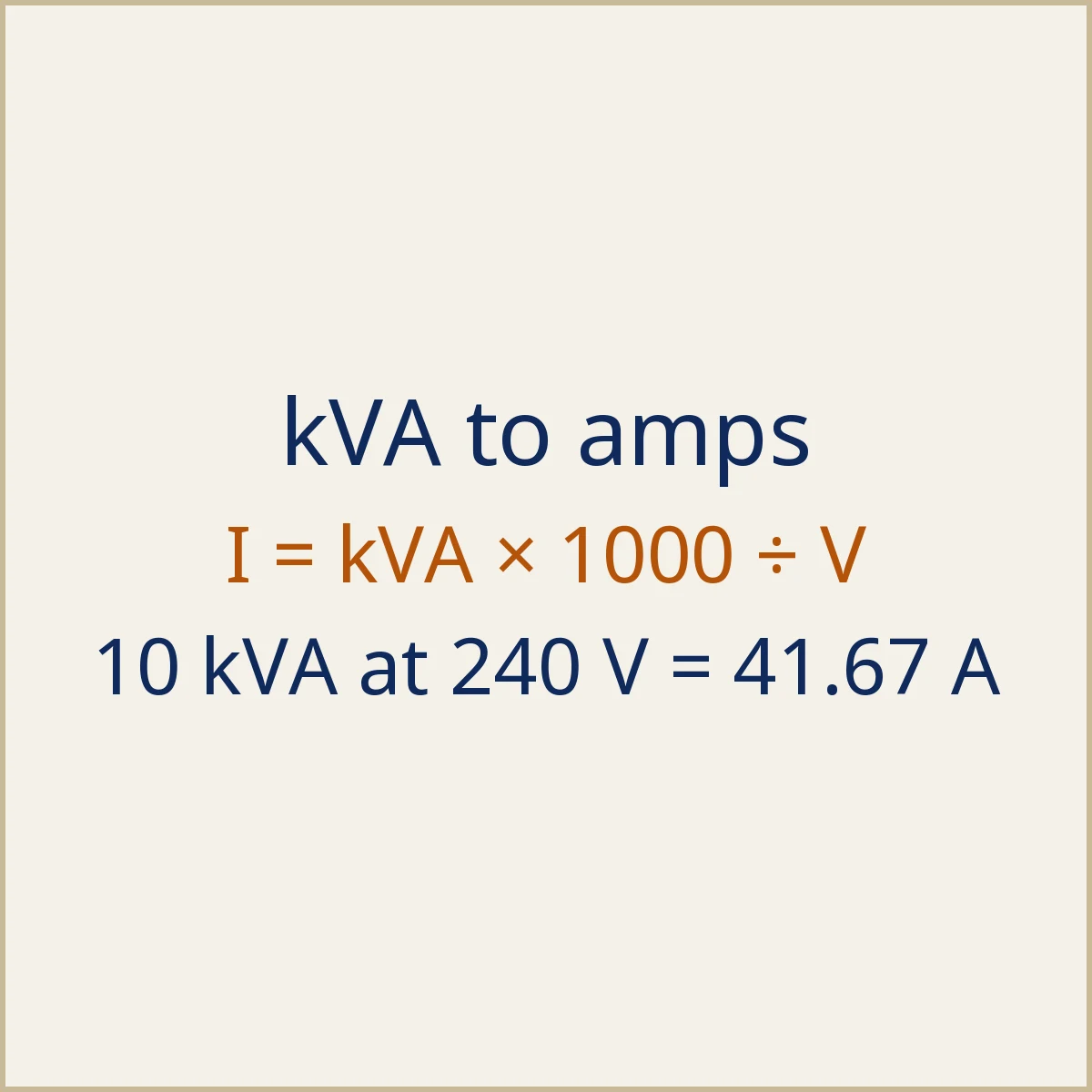
Worked example: a 10 kVA single-phase generator
At 240 V, I = 10 000 ÷ 240 = 41.67 A. At 120 V the same unit would be rated for 83.33 A. Real power in kW is kVA times the power factor, so a 10 kVA set at PF 0.8 delivers 8 kW.
kVA to amps: single-phase table
| kVA | Amps at 120 V | Amps at 240 V |
|---|---|---|
| 1 | 8.33 | 4.17 |
| 2 | 16.67 | 8.33 |
| 3 | 25 | 12.5 |
| 5 | 41.67 | 20.83 |
| 7.5 | 62.5 | 31.25 |
| 10 | 83.33 | 41.67 |
| 15 | 125 | 62.5 |
| 20 | 166.67 | 83.33 |
| 25 | 208.33 | 104.17 |
| 30 | 250 | 125 |
| 37.5 | 312.5 | 156.25 |
| 45 | 375 | 187.5 |
| 50 | 416.67 | 208.33 |
| 75 | 625 | 312.5 |
| 100 | 833.33 | 416.67 |
| 150 | 1250 | 625 |
| 200 | 1666.67 | 833.33 |
| 250 | 2083.33 | 1041.67 |
| 300 | 2500 | 1250 |
| 500 | 4166.67 | 2083.33 |
kVA to amps: three-phase table
| kVA | Amps at 208 V | Amps at 480 V |
|---|---|---|
| 1 | 2.78 | 1.2 |
| 2 | 5.55 | 2.41 |
| 3 | 8.33 | 3.61 |
| 5 | 13.88 | 6.01 |
| 7.5 | 20.82 | 9.02 |
| 10 | 27.76 | 12.03 |
| 15 | 41.64 | 18.04 |
| 20 | 55.51 | 24.06 |
| 25 | 69.39 | 30.07 |
| 30 | 83.27 | 36.08 |
| 37.5 | 104.09 | 45.11 |
| 45 | 124.91 | 54.13 |
| 50 | 138.79 | 60.14 |
| 75 | 208.18 | 90.21 |
| 100 | 277.57 | 120.28 |
| 150 | 416.36 | 180.42 |
| 200 | 555.14 | 240.56 |
| 250 | 693.93 | 300.7 |
| 300 | 832.72 | 360.84 |
| 500 | 1387.86 | 601.41 |
kVA, kW and amps are not the same
kVA is apparent power, kW is real power, and amps depend on kVA and voltage. For kW use watts: kW × 1000 equals watts, and the watts to amps calculator then needs the power factor. To go from amps back to watts, use amps to watts.
Return to the MicroCoulomb home page for other electrical conversions.
Frequently asked questions
How do you convert kVA to amps?
For single-phase divide kVA × 1000 by the voltage. For three-phase divide kVA × 1000 by √3 × the line-to-line voltage.
How many amps is 10 kVA?
At 240 V single-phase it is 41.67 A. At 208 V three-phase it is 27.76 A. At 480 V three-phase it is 12.03 A.
Is kVA the same as kW?
No. kW = kVA × power factor. They are equal only at a power factor of 1.
Why is the three-phase formula different?
Three-phase power is carried on three conductors, so total power is √3 × line voltage × line current.
Updated