
Watts to Amps Calculator (DC, AC 1-Phase & 3-Phase)
Watts to amps converts power in watts into current in amps using the voltage: amps equal watts divided by volts for DC, with power factor added for AC. This page has DC, single-phase and three-phase calculators, worked examples and tables for 120 V and 240 V.
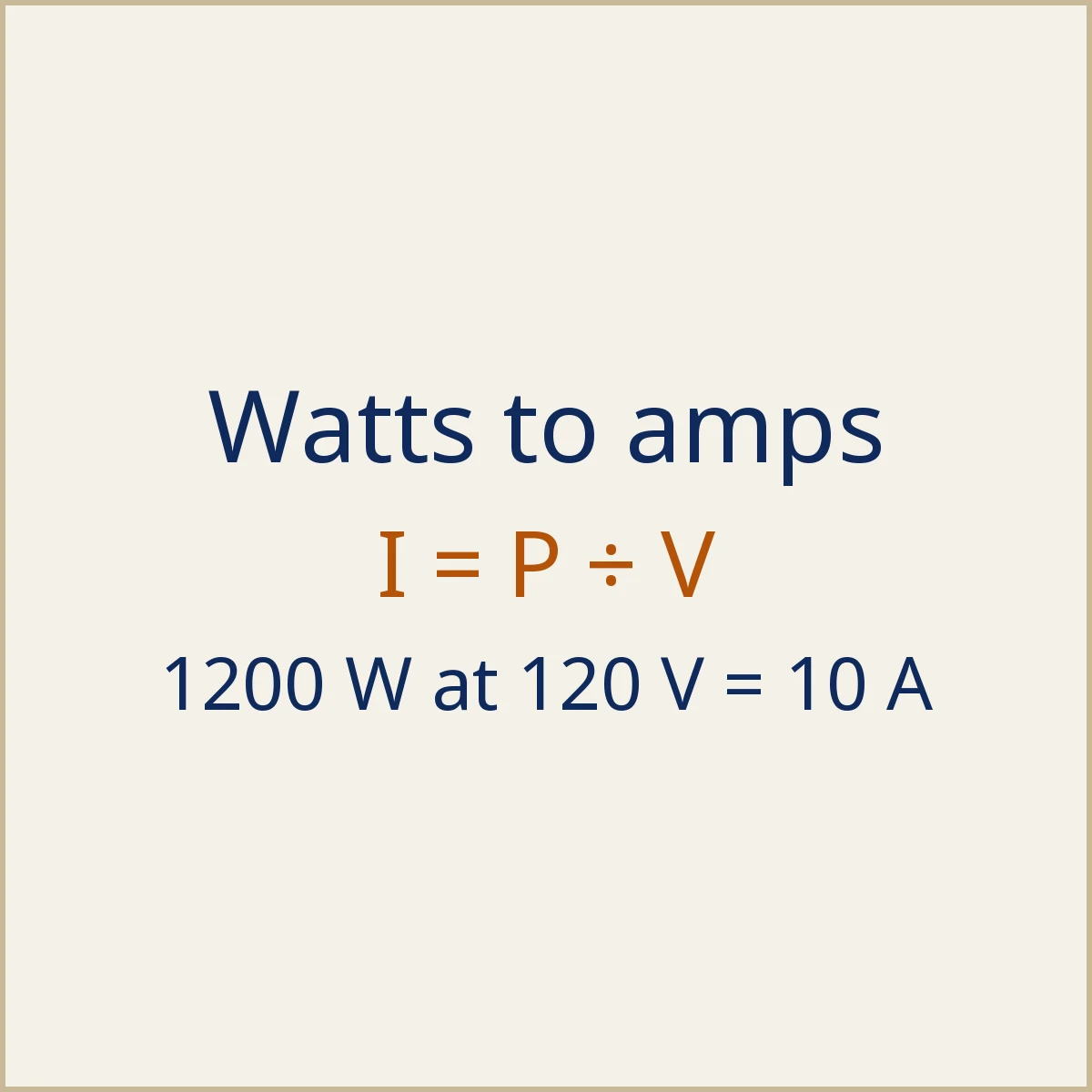
10 A I = P ÷ V → 1200 W with 120 V gives 10 A. 11.111111 A I = P ÷ (PF × V) → 1200 W with 120 V and PF 0.9 gives 11.111111 A. 30.841361 A I = P ÷ (√3 × PF × VL) → 10000 W with 208 V and PF 0.9 gives 30.841361 A.Watts to amps: DC
Watts to amps: AC single-phase
Watts to amps: AC three-phase (line-to-line)
How to convert watts to amps
Current is power divided by voltage. Which formula you use depends on the kind of circuit, because alternating current has a power factor and three-phase systems share the load across three conductors.
| Circuit | Formula | Example |
|---|---|---|
| DC | I = P ÷ V | 1200 W ÷ 120 V = 10 A |
| AC single-phase | I = P ÷ (PF × V) | 1200 W ÷ (0.9 × 120 V) = 11.11 A |
| AC three-phase, line-to-line | I = P ÷ (√3 × PF × VL) | 10000 W ÷ (1.732 × 0.9 × 208 V) = 30.84 A |
Worked example: a 1500 W heater on 120 V
With a power factor of 1 (a resistive heater), I = 1500 ÷ 120 = 12.5 A. On a 15 A circuit that is 83 percent of the rating, which is above the 80 percent limit for continuous loads, so a heater used for hours needs a larger circuit or a lower wattage.
Worked example: a 5000 W load on 240 V single-phase
At PF 0.9, I = 5000 ÷ (0.9 × 240) = 23.15 A. At PF 1 the same load draws 20.83 A. A lower power factor always raises the current for the same watts.
Power factor in one paragraph
In an AC circuit the current and voltage can be out of step. Real power in watts is the part that does work. Apparent power in volt-amperes (VA) is voltage times current. Power factor is watts divided by VA, a number from 0 to 1. Resistive loads such as heaters and incandescent lamps are near 1; motors and some power supplies are lower. If the nameplate gives only watts and no power factor, try 0.8 to 0.95 for a motor or electronics, and 1 for a heater.
Watts to amps table for 120 V and 240 V
Single-phase values at power factor 1 and at 0.9. Rounded to three decimal places.
| Watts | Amps at 120 V (PF 1) | Amps at 240 V (PF 1) | Amps at 120 V (PF 0.9) | Amps at 240 V (PF 0.9) |
|---|---|---|---|---|
| 60 | 0.5 | 0.25 | 0.556 | 0.278 |
| 100 | 0.833 | 0.417 | 0.926 | 0.463 |
| 150 | 1.25 | 0.625 | 1.389 | 0.694 |
| 200 | 1.667 | 0.833 | 1.852 | 0.926 |
| 300 | 2.5 | 1.25 | 2.778 | 1.389 |
| 400 | 3.333 | 1.667 | 3.704 | 1.852 |
| 500 | 4.167 | 2.083 | 4.63 | 2.315 |
| 600 | 5 | 2.5 | 5.556 | 2.778 |
| 750 | 6.25 | 3.125 | 6.944 | 3.472 |
| 800 | 6.667 | 3.333 | 7.407 | 3.704 |
| 1000 | 8.333 | 4.167 | 9.259 | 4.63 |
| 1200 | 10 | 5 | 11.111 | 5.556 |
| 1500 | 12.5 | 6.25 | 13.889 | 6.944 |
| 1800 | 15 | 7.5 | 16.667 | 8.333 |
| 2000 | 16.667 | 8.333 | 18.519 | 9.259 |
| 2400 | 20 | 10 | 22.222 | 11.111 |
| 3000 | 25 | 12.5 | 27.778 | 13.889 |
| 3500 | 29.167 | 14.583 | 32.407 | 16.204 |
| 4000 | 33.333 | 16.667 | 37.037 | 18.519 |
| 4500 | 37.5 | 18.75 | 41.667 | 20.833 |
| 5000 | 41.667 | 20.833 | 46.296 | 23.148 |
| 7500 | 62.5 | 31.25 | 69.444 | 34.722 |
| 10000 | 83.333 | 41.667 | 92.593 | 46.296 |
Three-phase table: line-to-line 208 V and 480 V
Power factor 0.9, using I = P ÷ (√3 × PF × VL).
| Watts | Amps at 208 V | Amps at 480 V |
|---|---|---|
| 3000 | 9.252 | 4.009 |
| 5000 | 15.421 | 6.682 |
| 7500 | 23.131 | 10.023 |
| 10000 | 30.841 | 13.365 |
| 15000 | 46.262 | 20.047 |
| 20000 | 61.683 | 26.729 |
| 30000 | 92.524 | 40.094 |
| 50000 | 154.207 | 66.823 |
Typical wattages to try
These are illustrative figures to try in the calculator, not product claims. Always use the rating on the appliance label.
| Load | Example watts | Amps at 120 V (PF 1) |
|---|---|---|
| LED bulb | 10 | 0.083 |
| Laptop charger | 65 | 0.542 |
| Television | 120 | 1 |
| Microwave oven | 1100 | 9.167 |
| Hair dryer | 1800 | 15 |
| Space heater | 1500 | 12.5 |
| Window air conditioner | 1000 | 8.333 |
Related converters
Go the other way with amps to watts, find average power from energy with kWh to watts, or convert small currents with milliamps to amps. Every converter is listed on the MicroCoulomb home page.
Low-voltage DC: 12 V, 24 V and 48 V
On a battery, solar or vehicle system the voltage is low, so the same watts mean much larger currents. A 100 W load draws 100 ÷ 12 = 8.33 A at 12 V, but only 100 ÷ 48 = 2.08 A at 48 V. That is why higher-voltage DC systems can use thinner cable for the same power. Use the DC calculator above with the battery voltage.
| Watts | Amps at 12 V | Amps at 24 V | Amps at 48 V |
|---|---|---|---|
| 10 | 0.833 | 0.417 | 0.208 |
| 24 | 2 | 1 | 0.5 |
| 50 | 4.167 | 2.083 | 1.042 |
| 100 | 8.333 | 4.167 | 2.083 |
| 150 | 12.5 | 6.25 | 3.125 |
| 200 | 16.667 | 8.333 | 4.167 |
| 300 | 25 | 12.5 | 6.25 |
| 500 | 41.667 | 20.833 | 10.417 |
| 1000 | 83.333 | 41.667 | 20.833 |
Common mistakes when converting watts to amps
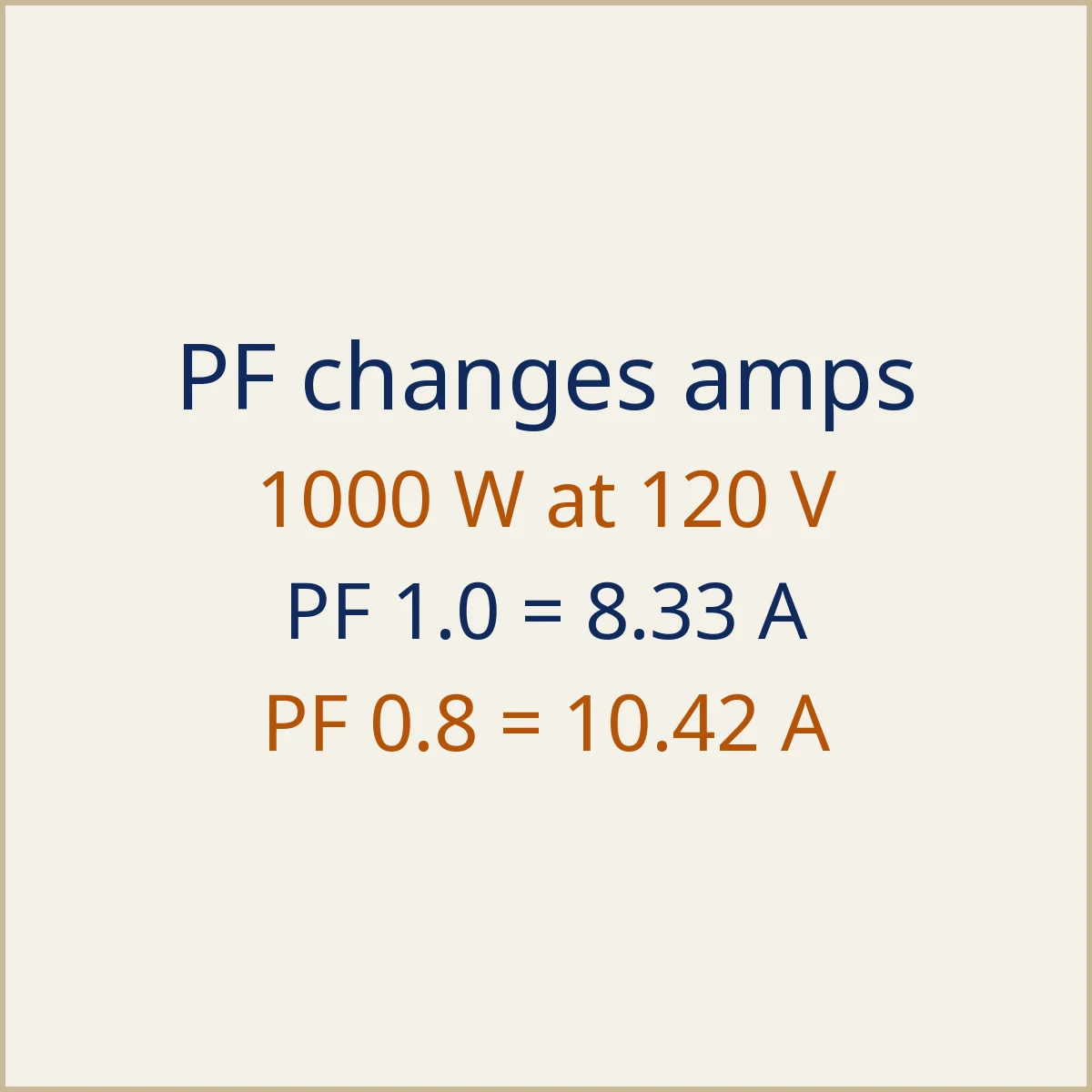
- Ignoring the power factor on AC. A motor rated 1000 W at PF 0.8 draws 1000 ÷ (0.8 × 120) = 10.42 A, not 8.33 A.
- Using phase voltage in a three-phase formula. The formula above uses the line-to-line voltage, such as 208 V or 480 V.
- Confusing watts and volt-amperes. A UPS rated in VA and one rated in watts are not interchangeable unless you apply the power factor.
- Forgetting continuous load limits. A load that runs for three hours or more should stay within 80 percent of the breaker rating under the NEC.
Why current matters more than watts for wiring
Wires heat because of current, not because of watts. Conductor size, plug rating and breaker size are all given in amps, so the watts-to-amps step is what connects an appliance label to a safe circuit. A rule of thumb for a first estimate: divide watts by the voltage, add a margin for power factor, then compare with the circuit rating. Final decisions belong to the code and a licensed electrician.
Frequently asked questions
How do you convert watts to amps?
Divide watts by volts for DC: amps = watts ÷ volts. For AC single-phase divide by volts times the power factor, and for three-phase divide by √3 × power factor × line voltage.
How many amps is 1000 watts?
At 120 V and a power factor of 1, 1000 W is 8.33 A. At 240 V it is 4.17 A. At 12 V DC it is 83.33 A.
Does the power factor matter?
Yes for AC loads. At PF 0.8 the same watts need 25 percent more current than at PF 1.
Is this safe to use for wiring?
The result is theoretical. Choose breakers and wire with the NEC and a licensed electrician.
Updated