
Ohm’s Law Calculator: Volts, Amps, Ohms & Watts
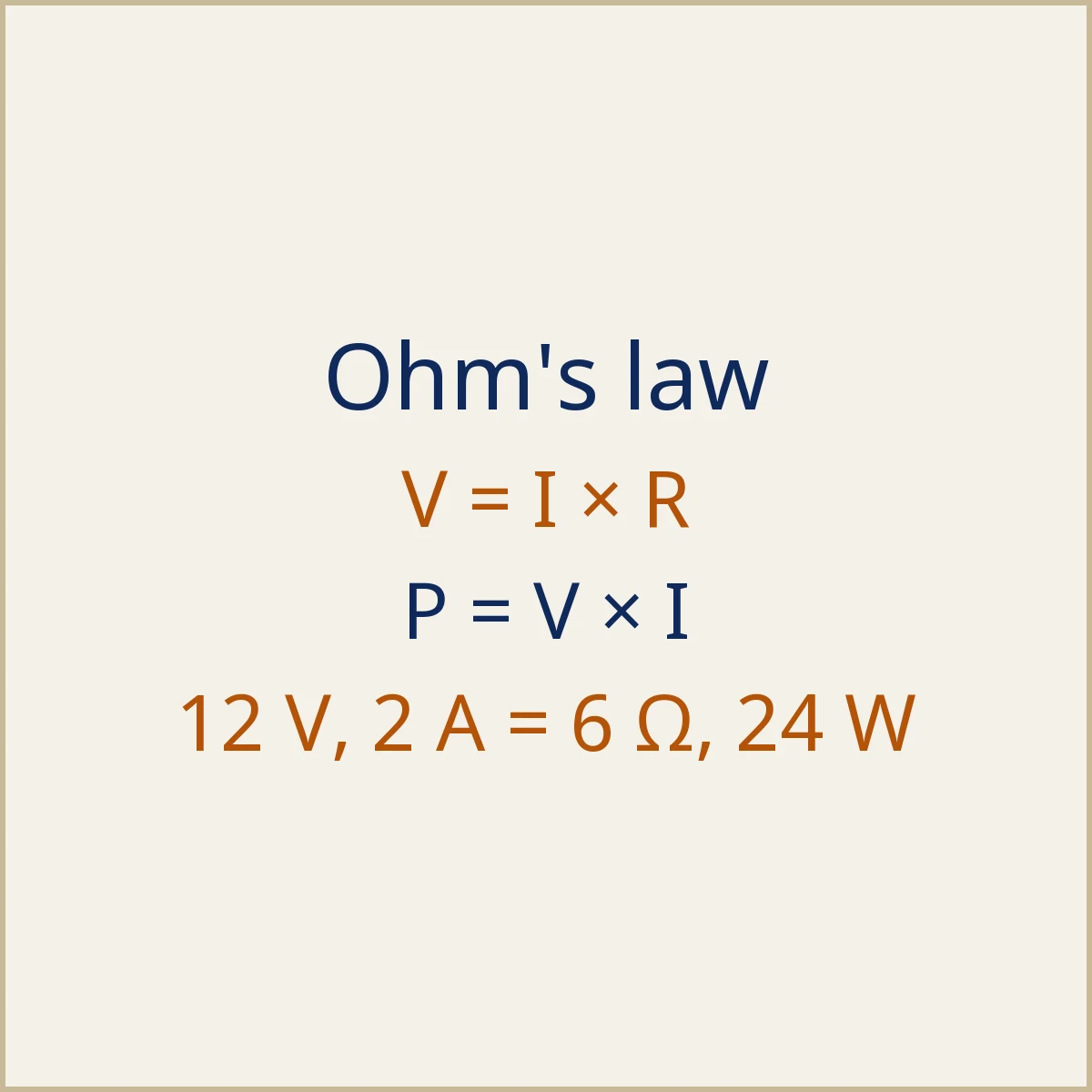
Ohm’s law says voltage equals current times resistance (V = I × R), and power equals voltage times current (P = V × I). Fill any two of volts, amps, ohms and watts in the calculator and the other two are worked out, with the formula shown and a table of the twelve equivalent formulas.
Ohm's law and power
Fill any two boxes and the other two are calculated. Sample: 12 V and 2 A.
R = 6 Ω, P = 24 W
R = V ÷ I = 12 ÷ 2 = 6 Ω; P = V × I = 12 × 2 = 24 W.
The twelve Ohm’s law and power formulas
Knowing any two of V, I, R and P gives the rest. Each pair has its own formulas.
| Known | Voltage V | Current I | Resistance R | Power P |
|---|---|---|---|---|
| V and I | — | — | V ÷ I | V × I |
| V and R | — | V ÷ R | — | V² ÷ R |
| V and P | — | P ÷ V | V² ÷ P | — |
| I and R | I × R | — | — | I² × R |
| I and P | P ÷ I | — | P ÷ I² | — |
| R and P | √(P × R) | √(P ÷ R) | — | — |
Worked example: a 12 V circuit with 2 A
R = 12 ÷ 2 = 6 Ω and P = 12 × 2 = 24 W. The resistor must be rated for at least 24 W, and in practice a larger rating gives margin.
Worked example: a 100 Ω resistor on 5 V
I = 5 ÷ 100 = 0.05 A = 50 mA and P = 25 ÷ 100 = 0.25 W, a typical quarter-watt resistor rating at its limit.
Current and power through 10 Ω
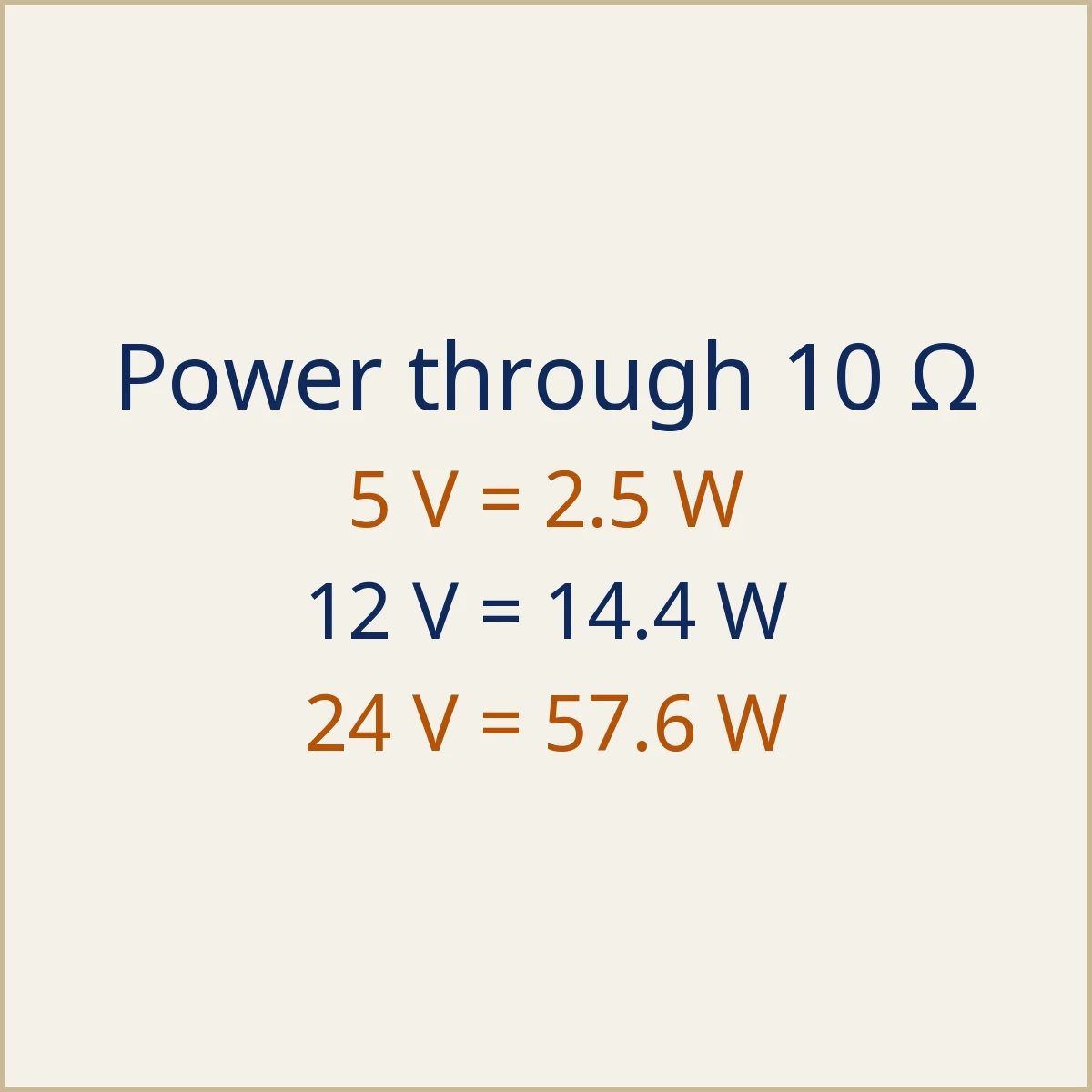
The table applies the formulas to a fixed 10 Ω resistor at common voltages.
| Voltage (V) | Current (A) | Power (W) |
|---|---|---|
| 1.5 | 0.15 | 0.225 |
| 3.3 | 0.33 | 1.089 |
| 5 | 0.5 | 2.5 |
| 9 | 0.9 | 8.1 |
| 12 | 1.2 | 14.4 |
| 24 | 2.4 | 57.6 |
| 48 | 4.8 | 230.4 |
| 120 | 12 | 1440 |
| 240 | 24 | 5760 |
Where Ohm’s law does not apply
Ohm’s law describes ohmic materials, where resistance is constant. Diodes, LEDs and lamp filaments do not follow it with a fixed R. For AC circuits with inductors and capacitors, impedance replaces resistance. For power in AC circuits see watts to amps and amps to watts.
More conversions are on the MicroCoulomb home page.
Frequently asked questions
What is Ohm’s law?
Voltage equals current times resistance: V = I × R. It links the volts across a resistor to the amps through it.
How do you calculate power from voltage and current?
P = V × I, in watts when V is in volts and I is in amps.
How do you find resistance from watts and amps?
R = P ÷ I². For example 24 W at 2 A gives 6 Ω.
Does the calculator work for AC?
Only for simple resistive loads. Reactive AC loads need impedance and the power factor.
Updated